.png)
New Beginnings: Culture in Hindi Cinema
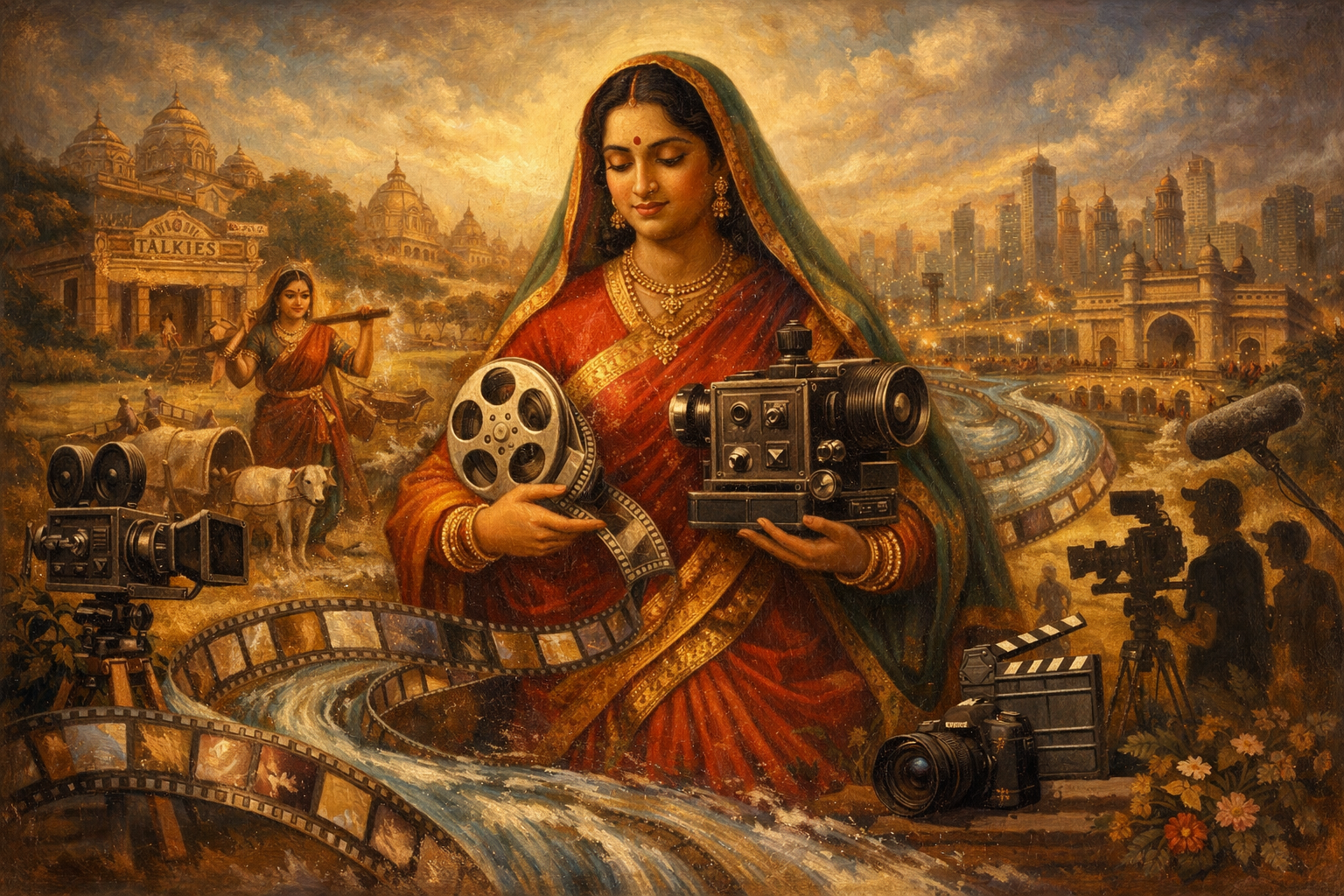
Hindi cinema has always been less a mirror and more a river absorbing tributaries of culture, memory, aspiration, and rebellion as it flows through time. To speak of “new beginnings” in Hindi cinema is not to point at a single year or movement, but to recognise a recurring instinct within the industry: the urge to reimagine Indian culture without severing it from its roots. Every generation of filmmakers has attempted, in its own way, to renegotiate tradition and modernity, belonging and alienation, faith and doubt. Culture in Hindi cinema is therefore not static folklore; it is lived, argued with, contradicted, and reborn.
In the early decades after Independence, Hindi cinema became a space where a newly formed nation tried to understand itself. Films like Do Bigha Zamin (1953) and Mother India (1957) framed culture around dignity of labour, sacrifice, and moral resilience. These were not just stories; they were emotional constitutions. The village was central not as an exotic postcard, but as a moral universe where ethics were tested under pressure. In Mother India, Radha’s struggle was not merely personal; it symbolised a civilisation grappling with change while holding on to its moral spine. Culture here was rooted in land, family, and endurance, yet it was never simplistic. Even tradition was shown as something that demanded courage, not blind obedience.
As urbanisation gathered pace in the 1960s and 70s, Hindi cinema began to question inherited values rather than merely celebrate them. Films like Guide (1965) and Anand (1971) marked an important cultural shift. Guide dared to place an unconventional woman, Rosie, at the centre of artistic self-realisation, challenging rigid social morality while still engaging deeply with classical Indian art forms like dance. Culture was no longer only about preserving norms; it became about personal liberation within an Indian emotional framework. Similarly, Anand used humour and tenderness to remind audiences that culture is also how we face death with grace, wit, and human connection.
The 1970s and early 80s, often remembered for their “angry young man” phase, also represented a cultural rupture. Films like Deewar (1975) and Ardh Satya (1983) reflected a society disillusioned with institutions. Here, culture was not expressed through rituals or romance but through conflict between morality and survival, law and justice. The mother figure remained sacred, but the system around her was corrupt. This tension created a new cinematic language where cultural identity was forged through resistance rather than reverence.
Parallel cinema of the same period offered a quieter but equally powerful redefinition of culture. Filmmakers such as Shyam Benegal, Govind Nihalani, and Sai Paranjpye explored regional textures, gender politics, and social hierarchies with remarkable sensitivity. Ankur (1974) and Bhumika (1977) examined feudal power and female agency without theatrical excess. These films treated culture as a lived reality unequal, uncomfortable, yet deeply human. They reminded viewers that cultural authenticity lies not in grandeur but in truth.
The 1990s marked another new beginning this time shaped by economic liberalisation and global exposure. Hindi cinema turned its gaze to the diaspora, crafting a cultural identity that travelled across continents. Films like Dilwale Dulhania Le Jayenge (1995) and Hum Dil De Chuke Sanam (1999) redefined Indianness as emotional allegiance rather than geographical location. Traditions were lovingly staged weddings, festivals, music but the underlying message was one of choice. Culture was something to be embraced voluntarily, not enforced. The idea that one could be modern, global, and still deeply Indian became a defining cinematic theme of the era.
In the early 2000s, Hindi cinema began engaging more openly with internal contradictions. Films such as Swades (2004) and Rang De Basanti (2006) explored the idea of return physical, emotional, and ideological. Swades offered a gentle, introspective look at development, community, and responsibility, suggesting that progress need not erase compassion. Culture here was not nostalgia; it was accountability. Rang De Basanti, meanwhile, used youthful energy and historical memory to question apathy, framing patriotism as ethical action rather than symbolic gesture.
As storytelling diversified in the 2010s, cultural representation became more intimate and decentralised. Small-town narratives like Udaan (2010), Masaan (2015), and Hindi Medium (2017) shifted focus from spectacle to nuance. These films portrayed culture through everyday anxieties parenthood, education, caste, aspiration without sermonising. Masaan, in particular, treated tradition with both reverence and critique, showing how rituals can coexist with tenderness and cruelty. The Ganges flowed through the film not as a religious emblem, but as a witness to human longing.
One of the most promising cultural shifts in recent Hindi cinema has been the emergence of women-centric and queer narratives that engage with tradition rather than reject it outright. They suggested that new beginnings do not always require new worlds sometimes they begin with reclaiming dignity within existing ones. Culture, in these stories, is neither villain nor saviour; it is a terrain to be navigated with honesty.
What distinguishes these cultural evolutions from propaganda-driven cinema is ambiguity. The best Hindi films do not tell audiences what to think; they invite them to feel, question, and reflect. They allow contradictions to breathe. Culture is portrayed not as a fixed slogan, but as a conversation between past and present, faith and doubt, self and society.
Hindi cinema’s greatest strength has always been its ability to reinvent cultural expression without abandoning emotional truth. New beginnings emerge when filmmakers trust the intelligence of their audience and the complexity of their society. As long as cinema continues to tell stories that are rooted yet restless, respectful yet questioning, Hindi cinema will remain what it has always been at its best a living archive of Indian culture in motion.
In the end, culture in Hindi cinema is not about looking backward or forward alone. It is about standing in the present, listening carefully, and daring to begin again and make that change.








.jpg)
.jpeg)